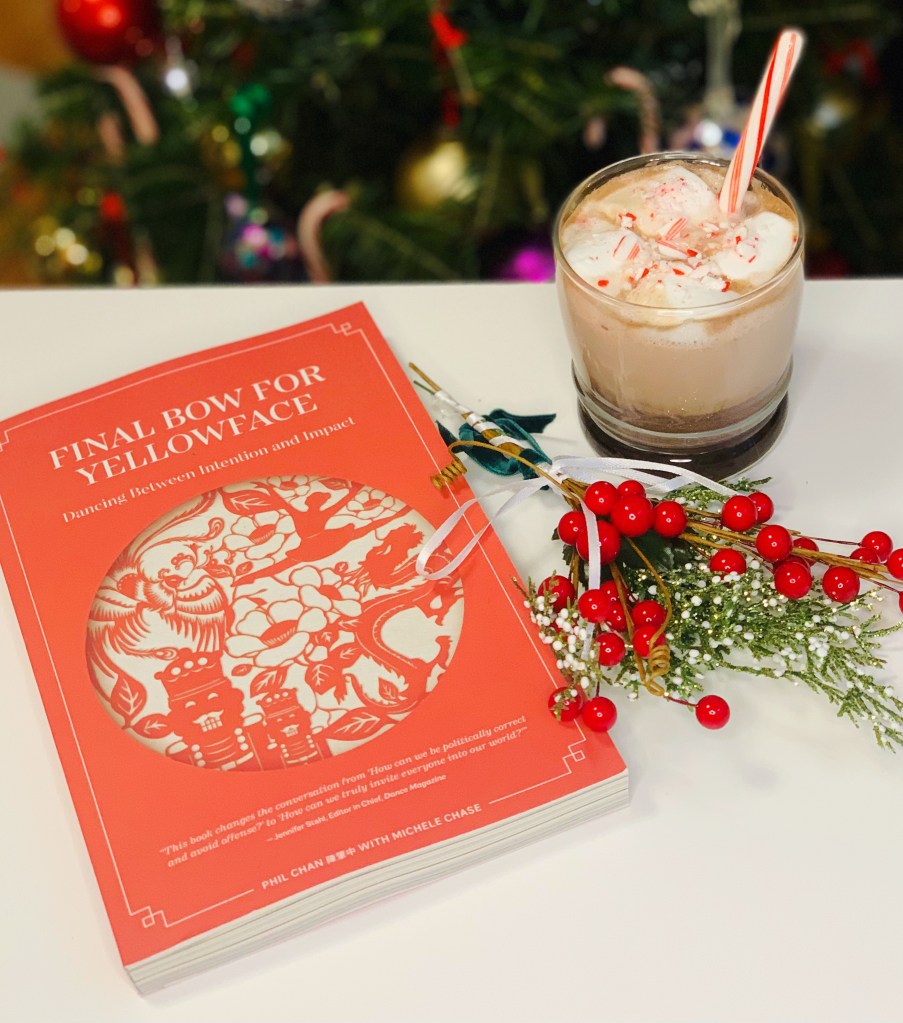
📖Final Bow for Yellowface: 🍸cozy cocoa

📖: Phil Chan’s (with Michele Chase) Final Bow for Yellowface (2020)
🍸: cozy cocoa

Why this book?

Merry Christmas everyone! 🎁 🎅🏽 🦌 One of my favorite holiday traditions is going to the ballet to watch The Nutcracker because it brings me fond memories of my performing years! 🩰 Since I can’t see it live in theatres this year, I’ll be watching virtual performances instead (ask in the comments or email me for recommendations).

I also just got myself a copy of Phil Chan’s Final Bow for Yellowface, which documents the author’s work in shifting the conversation on race and representation in classical ballet – particularly in the context of the “Chinese Tea Dance” in Act II of The Nutcracker. Unfortunately, it’s not uncommon for versions of this dance to include elements like conical hats, fans, dragons, folded hands, and shuffling feet movements as a caricature of Chinese representation. This is one of the several problematic dances in Act II that are based on outdated stereotypes of different nationalities. (Arabian coffee? Spanish chocolate? Russian candy canes? WHY?!)

I’m excited to dive into this book and learn more about the work that Final Bow for Yellowface is doing to make ballet more inclusive. As an Asian dancer, I want to see classical ballet repertory become less reliant on using orientalism as an avenue for awe and entertainment. Ballet has lasted over 500 years, evolving along the way. We don’t need to maintain ballet’s racist legacy to preserve its tradition.


Why this drink?

It’s Christmas so I’m drinking a spiked cocoa with this book, with Nutcracker music in the background. 😉 How do you like your hot chocolate? Minty? Spicy? Or just plain?

This recipe is from Celebrating Sweets blog’s Homemade Hot Chocolate.
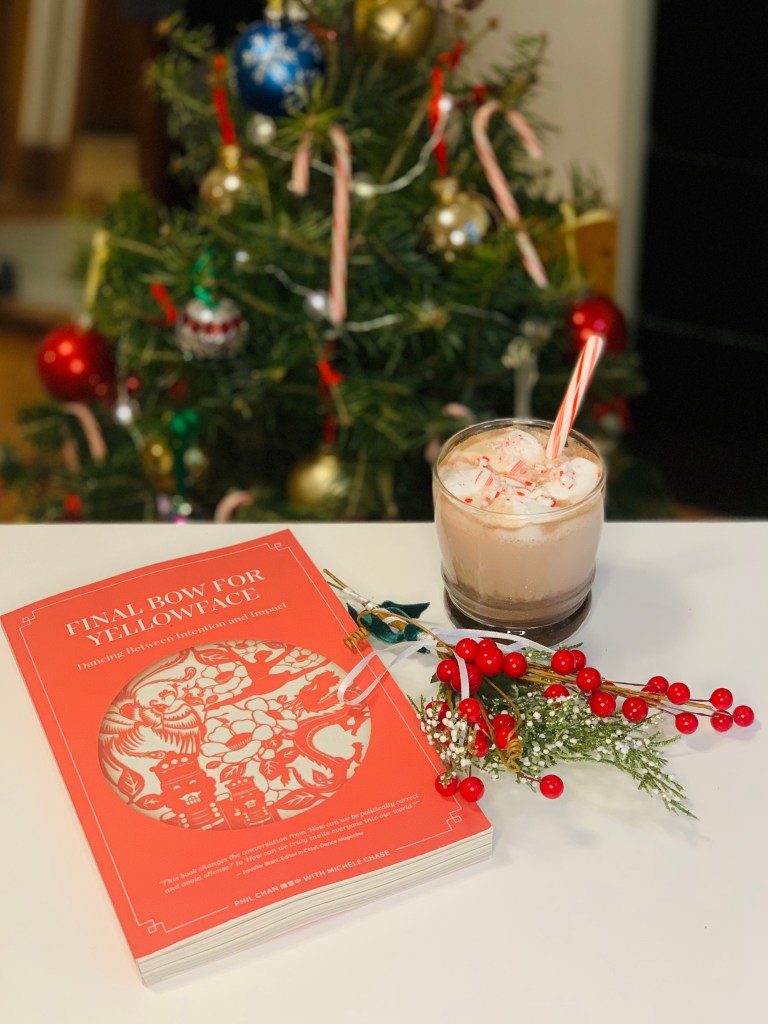

cozy cocoa

ingredients:
1 oz dark spiced rum
1 cup milk
1 tbsp cocoa powder (unsweetened)
1 tbsp sugar
2 tbsp chocolate chips
1-2 drops vanilla extract

garnish:
marshmallows or whipped cream
optional: crushed candy cane bits / stick or ground cayenne pepper

  1. Heat all ingredients, except chocolate chips, over the stove until warm (not boiling).
  2. Add chocolate chips and whisk until melted.
  3. Serve with marshmallows or whipped cream. You can add crushed candy cane for a mint cocoa, or sprinkle some cayenne pepper on top for a spicy kick.

Let’s discuss!

Finished the book? What did you think about it? Share your thoughts in the comments section below!

📖Good Talk: 🍸holiday talk

📖: Mira Jacob’s Good Talk (2018)
🍸: holiday talk

Why this book?

The holidays are usually a time with family (albeit socially distant this year), and this time can come with difficult and uncomfortable conversations. Mira Jacob’s graphic memoir is a timely and relevant read, especially during everything that’s happened this year — the pandemic, Black Lives Matter, the elections.

The conversations in this book can be serious, funny, and ambivalent, but always full of things to unpack and process. I read this book shortly before the US presidential election, and appreciated the parts that covered the author’s experience of living through the 2016 elections. It’s scary how four years later now, we’re still feeling anxious and fearful about the future of our leadership and democracy, and what kind of place this country will be like for people of color.

I especially enjoyed the candid way Mira Jacob presented her conversations with her son, husband, and in-laws, on the topic of race. Even though I’m not a parent, I am in an interracial relationship, and the nuances of these conversations resonated with me.

The central question the book left me with is: how do we navigate relationships with loved ones whose politics directly clash with our own values and identities as people of color? There is no clear-cut answer, but I finished the book feeling hopeful about how engaging in continuous conversations — especially with young people — can help move us toward a better future world.


Why this drink?

I chose a holiday-themed drink for this pairing – also to match the book’s red cover. (The recipe comes from Williams Sonoma’s Pomegranate Champagne Cocktail.) Wishing you a restful and healthy holiday! 🥂


holiday talk

ingredients:
1 oz pomegranate juice
0.5 oz triple sec
3 oz or more of champagne

garnish:
pomegranate seeds, orange peel, and mint

  1. Combine pomegranate juice and triple sec in a chilled glass.
  2. Top off with champagne, and add garnishes.

Another round, please! 🥂
You might also like:
Thi Bui’s The Best We Could Do (2017)

Let’s discuss!

Finished the book? What did you think about it? Share your thoughts in the comments section below!

📖The Mountains Sing: 🍸grandma’s guava

📖: Nguyễn Phan Quế Mai’s The Mountains Sing (2020)
🍸: grandma’s guava

Why this book?

There’s so much that I have to learn about Vietnamese history, as well as the history of my own family before we left Vietnam in the early 90’s. Sadly, my Vietnamese language skills are limited, and this makes it hard for me to ask for and understand all the stories my grandparents can share with me about the years leading up to the Vietnam war. So, I was thrilled to read this beautiful novel about a family in 20th century Vietnam, giving me a glimpse into a place and time that I want to learn more about.

This multi-generational story highlights major events like the Japanese occupation, land reforms, the war, and its aftermath. I kept thinking about my family the entire time I was reading it. Where were my grandparents or parents during these major events? What were they doing? How did they feel? I need to do a better job of exploring and documenting my own family history.

In writing this deeply moving novel, Nguyễn Phan Quế Mai advocates for cross-cultural understanding and empathy to avoid future wars. One of the most powerful things in this story was the portrayal of characters who offer compassion and forgiveness to those who have inflicted great losses on them – especially when those “enemies” are not from other countries, but are fellow neighbors, friends, or family. While the memory of the Vietnam War lasts beyond its end, I think this story helps us take a step towards understanding and healing.


Why this drink?

I am pairing this book with a simplified adaptation of the Liquid Culture blog’s Mama Guava cocktail, in honor of the protagonist. Guava and coconut are also commonly found in Vietnam, while the spices infuse the drink with some wintery holiday vibes.


grandma’s guava

ingredients:
1.75 oz coconut rum
0.75 oz guava juice
0.3 oz lemon
0.25 oz winter spice syrup
1 oz water
2 dashes angostura bitters

garnish:
ground nutmeg, Vietnamese cinnamon stick, and Thai basil

  1. To make the winter syrup, bring 1 part water and 1 part sugar to boil with a dash of ground cinnamon, nutmeg, cloves, and vanilla extract.
  2. Combine the syrup with all other ingredients in a shaker, and shake with ice.
  3. Strain into a glass with fresh ice and garnish.


Another round, please! 🥂
You might also like:
Marisel Vera’s The Taste of Sugar (2020)

Let’s discuss!

Finished the book? What did you think about it? Share your thoughts in the comments section below!

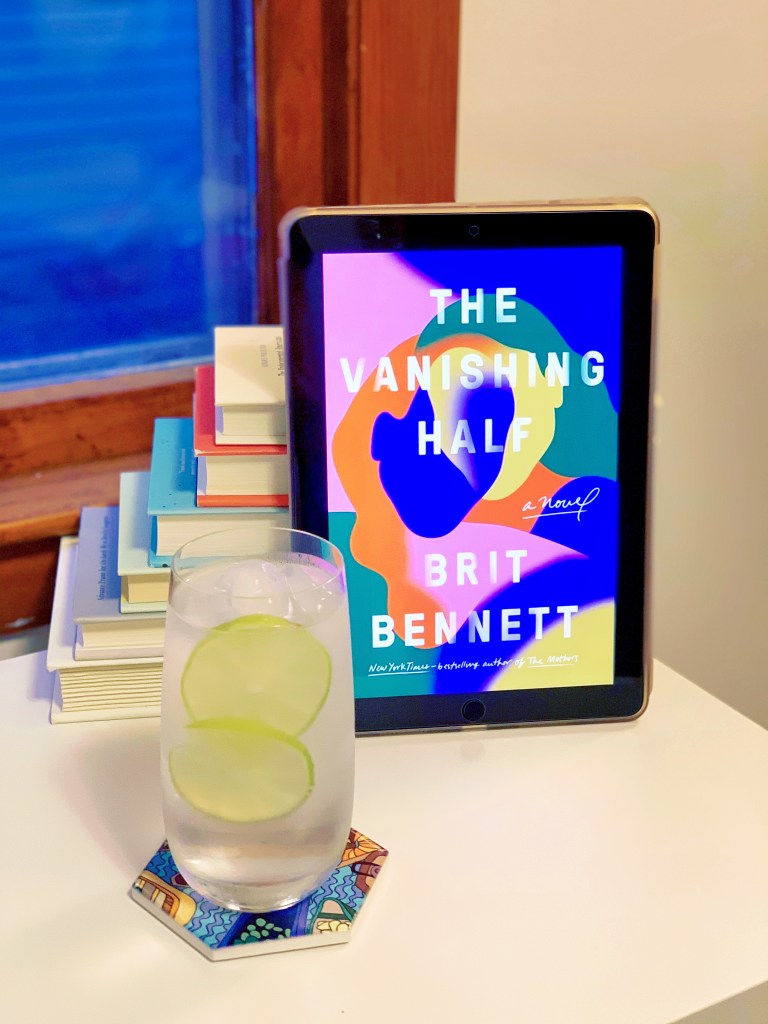
📖The Vanishing Half: 🍸twin sister

📖: Brit Bennett’s The Vanishing Half (2020)
🍸: twin sister

Why this book?

This novel begins as a story of two biracial twin sisters, Stella and Desiree, who leave their small black community in Louisiana for New Orleans. One day, Stella suddenly vanishes to live a secret life passing as a white woman. While Stella and Desiree’s lives increasingly diverge over time, they are inextricably bound together by unanswered questions, grief, longing, and ultimately, their daughters.

“Why wouldn’t you be white if you could be?” Stella thinks as she reflects back on her life. “Remaining what you were or becoming something new, it was all a choice, any way you looked at it. [Stella] had just made the rational decision.”

Beyond the sisters’ plot line, this is a broader, multigenerational story of transformation. Other characters also dramatically change — some by choice, and others not. There are individuals who undergo gender transitions, strive for socioeconomic mobility, become single parents, lose their memory due to illness, or turn into abusive partners. The premise captivated me from the beginning, and when I got to the end, I still wanted to know more about the characters, who were each so textured and full of humanity. Especially Jude and Reese and Early.

The book left me with many questions on identity. How do we see and define ourselves in a world that values only whiteness? How much of our choice to transform is rooted in self-love, self-acceptance, or self-hate? Whatever we choose to be, how much of that choice should be judged as right or wrong (or even judged at all)?


Why this drink?

I’m pairing this novel with a gin & tonic because Stella enjoys lounging in her pool with a gin soda-like drink in hand. I also chose this drink for its transparency, which, like Stella, seems to vanish in to its surroundings.


twin sister

ingredients:
2 oz gin
4 oz tonic water

garnish:
two lime wheels

  1. pour gin and tonic over ice
  2. stir and add more tonic water, if desired
  3. add two lime wheels (one for each twin!)


Another round, please! 🥂
You might also like:
Chimamanda Ngozi Adichie’s Half of a Yellow Sun (2006)

Let’s discuss!

Finished the book? What did you think about it? Share your thoughts in the comments section below!

And check out The Vanishing Half Book Club Kit, which includes its own custom cocktail pairing! 😍

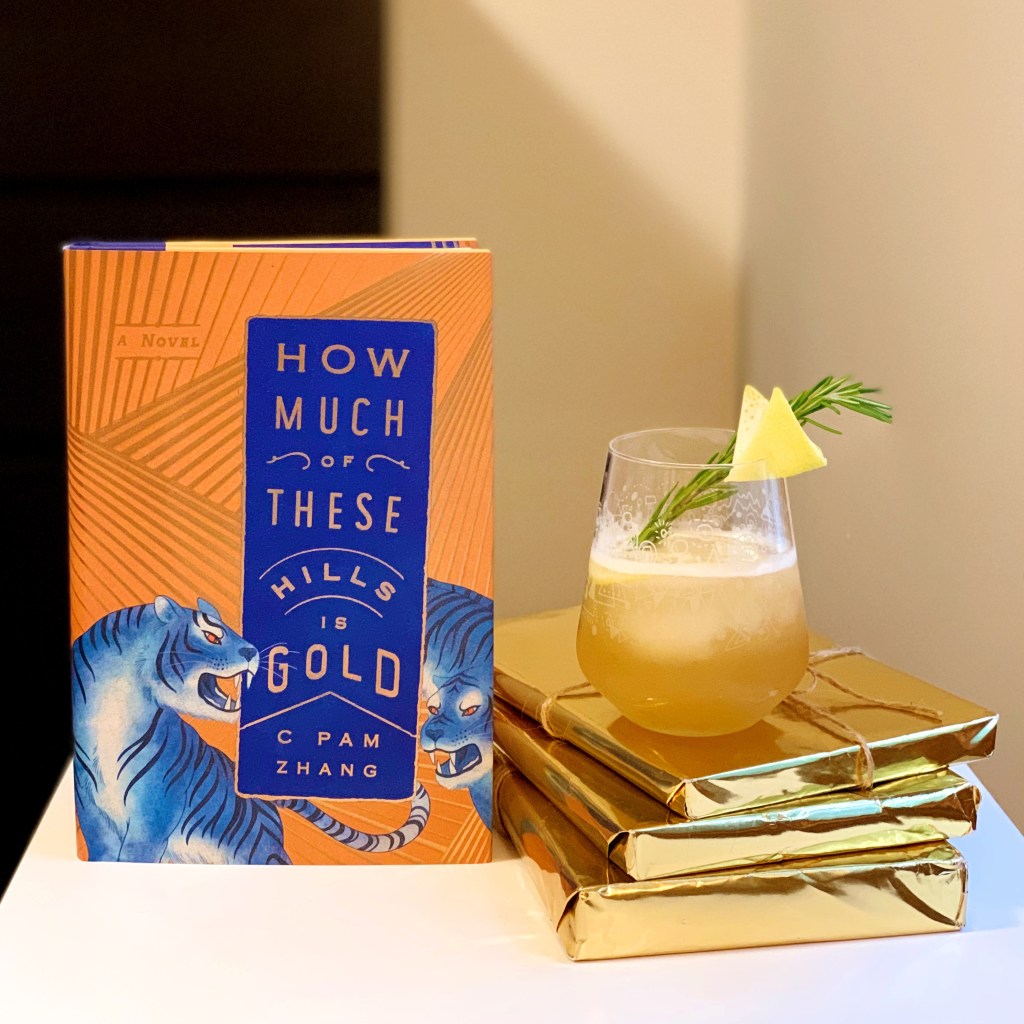
📖How Much of These Hills is Gold: 🍸gold grass

📖: C Pam Zhang’s How Much of These Hills is Gold (2020)
🍸: gold grass

Why this book?

“This land is not your land.” This is the epigraph that opens this luminous novel about two orphaned Chinese American siblings that venture through the American West, in search of a new home.

But no matter where they go, they are still outsiders, and even though they were born on this land, they are excluded from owning any of it. On top of it all, the land was stolen from Indigenous Peoples, so it was never theirs to claim in the first place.

In a word, this novel was poignant. In thinking about my experiences as an immigrant in America, I related to Lucy and Sam’s feelings of being “othered” in the only place that feels like home. Like the children, I want that unquestionable sense of belonging, but it can remain elusive.

Another part of the novel that I kept thinking about was Lucy’s rejection of Ba’s fantastical tales about the land before the gold miners’ arrival. She favors the neatly packaged history she learns in school. Maybe because this sanitized version of history gives her hope that she can still find her place in this country. Or maybe it allows her to feel that her family isn’t also implicated in exploiting the land, despite their prospecting activities.

This aspect of the novel made me reflect on Baldwin, Coates, and Laymon’s idea of how much our country wants to avoid the truth behind our history, and in doing so, defines who can and can’t belong here. The versions of history we choose to believe indeed matter.

I love that this novel centers the experience of a Chinese American family in the West. And I appreciated that their narrative is complicated by the knowledge of how Indigenous Peoples are impacted as the family searches for prosperity. What does it mean to belong to a land that doesn’t belong to you? I can’t wait to see what C Pam Zhang will write next.


Why this drink?

I’m pairing this novel with the Gold Rush cocktail since this period sets the stage for the story.


gold grass

ingredients:
2 oz bourbon
0.75 oz lemon juice
0.75 oz honey syrup

garnish:
lemon peel and rosemary

  1. to make the honey syrup, heat 3 parts honey with 1 part water over the stove until the mixture dissolves into a syrup
  2. combine all ingredients in a shaker, and shake with ice
  3. strain into a chilled glass with fresh ice and garnish with lemon and rosemary


Another round, please! 🥂
You might also like:
Wendy Law-Yone’s The Coffin Tree (1983)

Let’s discuss!

Finished the book? What did you think about it? Share your thoughts in the comments section below!
And check out this interview with C Pam Zhang to learn more about How Much of These Hills is Gold:

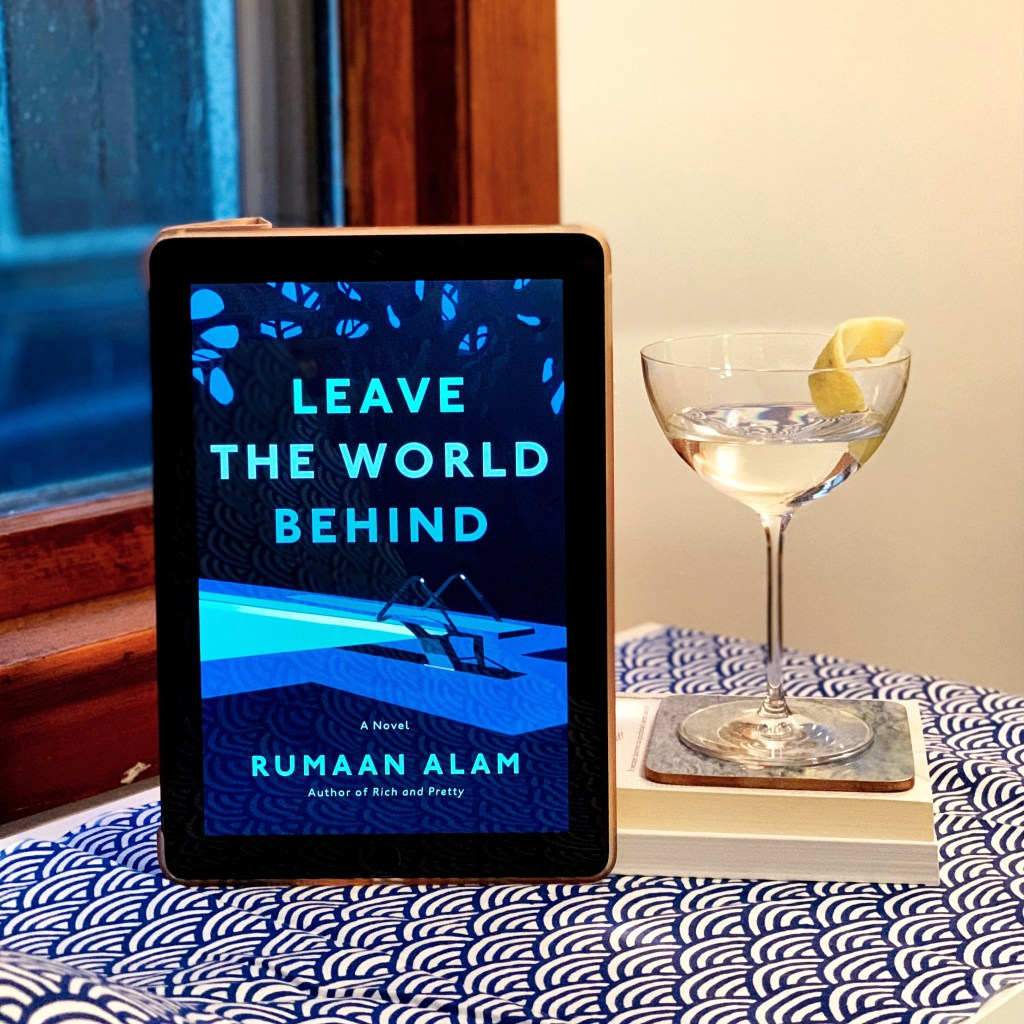
📖Leave the World Behind: 🍸clarity

📖: Rumaan Alam’s Leave the World Behind (2020)
🍸: clarity

Why this book?

This is the kind of book where you know what’s going to happen (broadly), but you don’t really know what’s actually happening. 🤔

Two families — strangers to each other — are sequestered in an isolated AirBnb home in the woods of Long Island. They know that NYC has lost all power but don’t know what kind of danger they are in. There’s no access to information. So WHAT exactly is happening?

Could it be an act of war, environmental disaster, or pandemic? The author drops frequent commentary on the declining state of the world to lead us to speculate just as much as the characters do. The expanding sense of foreboding kept me engaged throughout the book, even when I didn’t find any satisfying answers.

By the end, I felt that the book is less interested in uncovering the source of the crisis, than it is in posing bigger questions about life and the world that we’ve created:

  • How do we live our life when the end may be near, but don’t know how or when it will come? 
  • How much of our humanity or inhumanity do we reveal in times of crisis? 
  • Can we truly prevent the end of the world? If the warning signs have been hidden in plain sight all along, how have we blinded ourselves from seeing this truth? 

I recommend this if you’re in the mood for a story with major pandemic vibes and ambiguous plot lines. Or if you want to read a book with lots of uncommonly used words to brush up on your vocab (great for GRE prep or NYT crosswords! 🤓). Overall, the story was effective in urging me to fully focus on the present — because what else can you do when everything as you know it is at stake?


Why this drink?

This novel’s pairing is a vodka martini because I suspect the family members are drinking some variation of this cocktail as they nervously wait for news. One of them had bought a bottle of Tito’s from the grocery store, which ends up being served with ice and lemon. A couple rounds of these will definitely help with leaving the world behind.


clarity

ingredients:
2 oz vodka
1 oz dry vermouth
2 dashes orange bitters

garnish:
lemon peel

  1. combine all ingredients in a mixing glass with ice and stir well
  2. strain and serve in a chilled glass
  3. express the lemon peel and garnish the drink with it


Another round, please! 🥂
You might also like:
Ling Ma’s Severance (2018)

Let’s discuss!

Finished the book? What did you think about it? Share your thoughts in the comments section below!
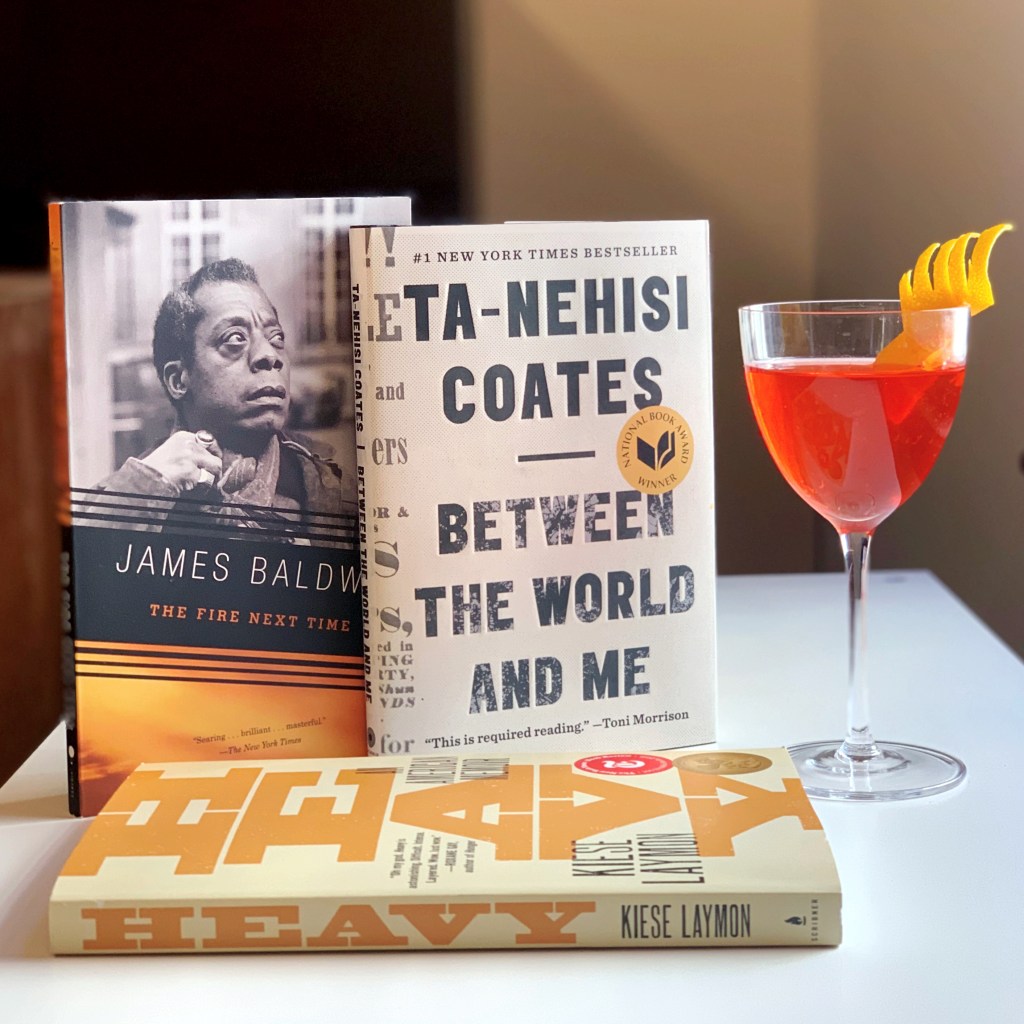
📖The Fire Next Time | 📖Between the World and Me | 📖Heavy: 🍸beauty wisdom abundance

📖: James Baldwin’s The Fire Next Time (1963)
📖: Ta-Nehisi Coates’s Between the World and Me (2015)
📖: Kiese Laymon’s Heavy (2018)
🍸: beauty wisdom abundance

Why this book?

I read all three of these books in quick succession, and the experience of doing so was like having Baldwin, Coates, and Laymon all in the same room talking to each other. 

In these books, all three writers try to unpack the question of what it means to be free as a black man in America. They examine the all ways that white supremacy destroys black bodies — through police brutality, incarceration, violence, poverty, and health disparities. “Black life is cheap,” Coates states, “but in America black bodies are a natural resource of incomparable value.” Our denial of America’s history of exploitation is at the root of what Baldwin calls our country’s “racial nightmare.” Laymon powerfully expresses this when he writes, “No one in my family—and very few folk in this nation—has any desire to reckon with the weight of where we’ve been, which means no one in my family—and very few folk in this nation—wants to be free.”

It feels devastating but urgent to read Baldwin’s observations on race and know that they remain as timely as ever. Coates’ letter to his son felt like a really powerful contemporary extension of the sentiments that Baldwin relayed in his own letter to his nephew in 1962. And I especially loved the intimacy and rawness of Laymon’s memoir, in the way that he uncovers his fraught relationship with his body and family, showing us how deeply embedded the effects of racism are in the personal sphere as they are in the political.

Aside from the searing social critique, each book provides a beautiful portrait of its respective artist. All three men reflect on the beauty, wisdom, or abundance they see as part of their black identity, and how that has helped them to not only survive, but also fuel their writing. These are among the most impactful books I’ve read this year, and I’ll be sure to revisit them often. I highly recommend prioritizing them if you haven’t read them yet!


Why this drink?

Because I think these three books are really amazing companions works, I’m pairing them with the Old Pal cocktail, which is made of only 3 ingredients, all in equal measure.


beauty wisdom abundance

ingredients:
1 oz rye
1 oz Campari
1 oz dry vermouth

garnish:
orange peel

  1. stir all ingredients in a mixing glass with ice, until chilled
  2. strain into a chilled glass
  3. garnish with orange peel

Another round, please! 🥂
You might also like:
Saeed Jones’s How We Fight for Our Lives (2019)

Let’s discuss!

Finished the book? What did you think about it? Share your thoughts in the comments section below!