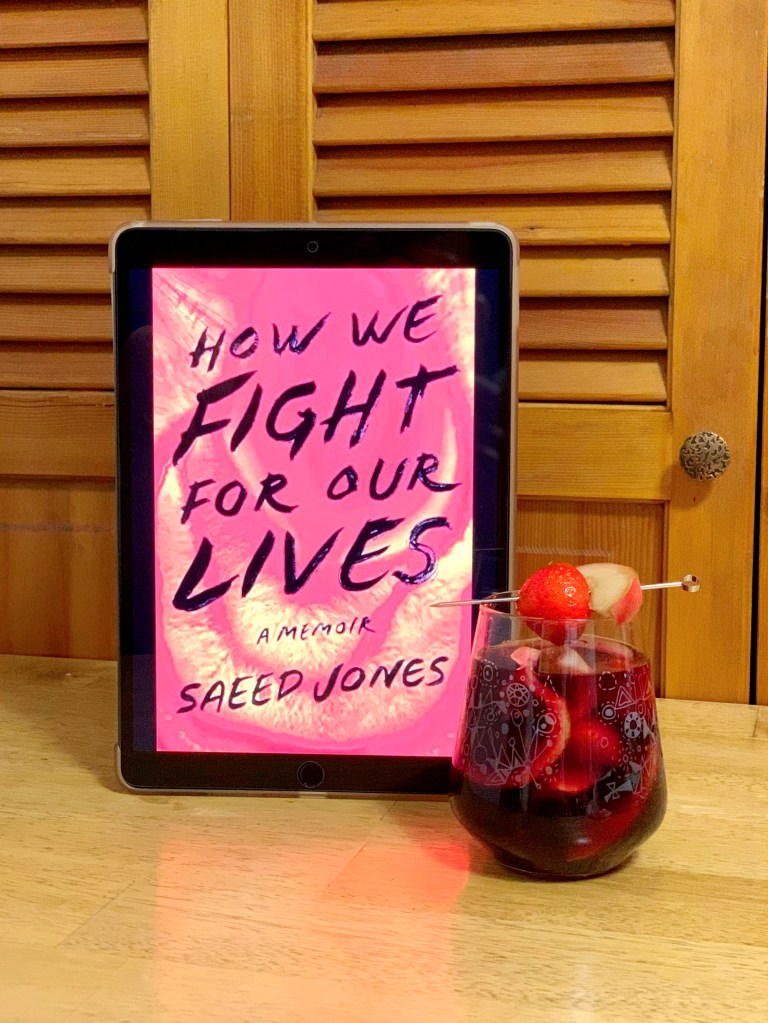
📖How We Fight for Our Lives: 🍸sangria in spain

📖: Saeed Jones’s How We Fight for our Lives (2019)
🍸: sangria in spain

Why this book?

Today is the last day of Pride Month, so I’m recommending Saeed Jones’ How We Fight for Our Lives, a poetic coming-of-age memoir that follows Jones’ experiences growing up as a gay black boy in the South through his early adulthood, navigating his relationship with his mother. In his story, Jones fights not just for physical survival as a black, gay man, but he also fights to claim his right to be himself at the intersection of his marginalized identities. Jones’ struggle for agency and power are intimately tied to his attempts to define himself in a world that is anti-black and anti-gay.

The book is also about Jones’ mother as it is about him. It begins with her and ends with her, despite Jones’ efforts to detach himself from his mother in his journey in finding himself. The memoir aptly closes with a reflection on how “our mothers are why we are here.” They are why we are.


Why this drink?

I made this drink because Jones shares bottles of sangria with a new friend Esther, who he meets on a visit to Barcelona. They tour museums, go to the beach, share meals together, and mutually realize that their mothers are the reason why they both decided to take this trip to Spain. I wanted to highlight this moment of discovery, hope, and comfort that these two individuals found towards the end of the story.


sangria in spain

ingredients:
1 bottle red wine
4 oz brandy*
1 oz maple syrup*
1 orange
1 lemon, thinly sliced into rounds
3 cups of your favorite seasonal fruit, chopped up*

  1. cut the orange in half. juice one half and thinly slice the other half into rounds.
  2. red wine, brandy, orange juice, and maple syrup in a large pitcher or carafe, and mix well (or shake well if your pitcher/carafe has a lid)
  3. add the chopped fruit, and lemon and orange slices to the mixture. let the flavors infuse for at least half an hour before serving.
  4. you may leave it in the fridge to chill for 2-8 hours, if desired.
  5. serve with ice, optional.

quarantine substitutes:
If you don’t have brandy, I’ve read that you can replace it with a black spiced rum. I haven’t tried that but that sounds like it could be really interesting!
If you don’t have maple syrup, you can sub with a simple syrup made with regular white, granulated sugar or demerara sugar. You can also simply mix in white or brown sugar without making a syrup.
Seasonal fruits: use anything you’d like and/or whatever is available. I used peaches, strawberries, and blueberries because it’s summer. Apples, pears, nectarines, and pineapples also work. You can also add more or less lemon/orange to taste. The 3 cups measurement of chopped fruit is just an estimate — add accordingly based on your love for fresh fruit!

Thanks to Cookie + Kate for their Best Sangria Recipe !!


Another round, please! 🥂

You might also like:
Kiese Laymon’s Heavy (2018)


Let’s discuss!

Finished the book? What did you think about it? Share your thoughts in the comments section below!

And check out these reviews to learn more about the book:

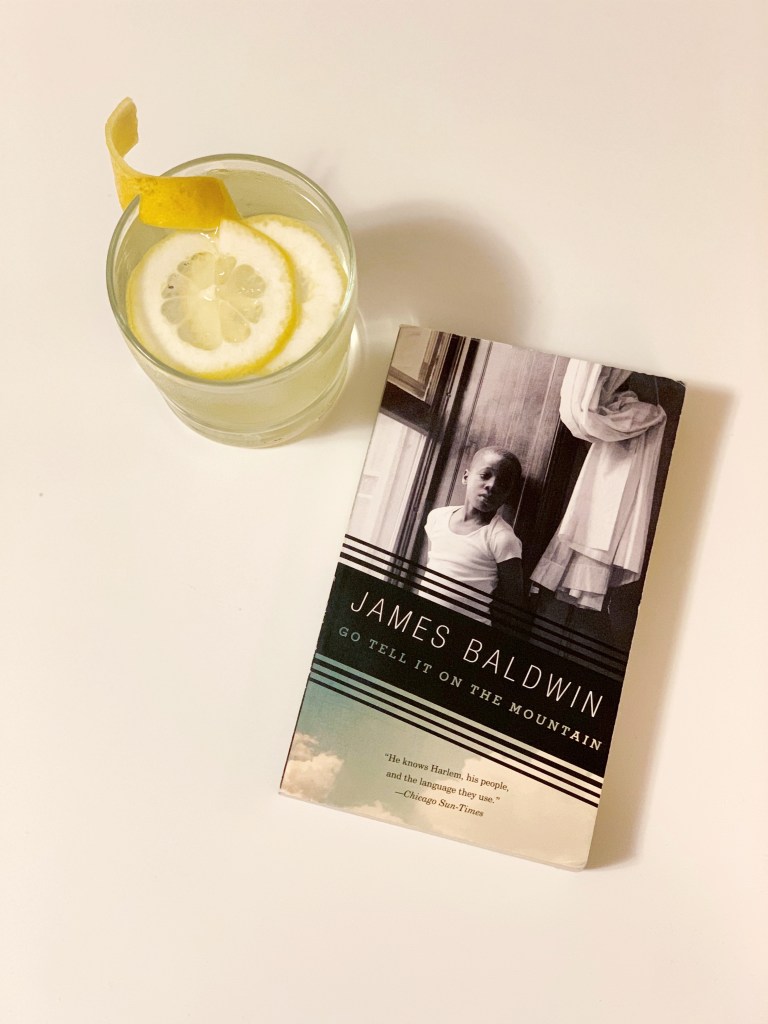
📖Go Tell It on the Mountain: 🍸fourteen

📖: James Baldwin’s Go Tell It On the Mountain (1953)
🍸: fourteen

Why this book?

Go Tell It on the Mountain is James Baldwin’s first novel, published in 1953. It begins with the main character John’s fourteenth birthday, a day when John begins to question his faith, sexuality, and destiny as a preacher.

Much like the novel’s protagonist, James Baldwin also became a preacher at age 14, after a life-changing prayer meeting at his church. However, after some years, he became disillusioned with Christianity, left the ministry, and at age 24, moved to Paris to continue writing and to experience life outside of the racist confines of America.

Baldwin returned to the US in the late 1950’s and became a prominent voice and essayist analyzing issues of race, power, and class during the civil rights movement. As a gay man, Baldwin also wrote stories that explored ideas of queer sexuality and masculinity. His works were also influential in the gay rights movement, in addition to the civil rights movement.

Even almost seventy years after his first publication, much of Baldwin’s writing and social analyses remain extremely contemporary. While The Fire Next Time is resurging in popularity today, I thought it would be interesting to go back to Baldwin’s first work, to see where he began as a writer and understand how his ideas on race, class, sexuality, and faith developed over the course of his career as a writer and activist.


Why this drink?

The second section of this book is titled “The Prayers of the Saints,” which gives readers insight into the history and perspective of John’s family members. As a nod to this section of the book, this cocktail will feature elderflower liqueur as a key ingredient (St. Germain and St. Elder are two brands that produce this spirit).


fourteen

ingredients:
3 oz dry white wine*
2 oz elderflower liqueur
1 oz club soda

for garnish:
lemon twist

  1. mix all ingredients in a mixing glass with ice.
  2. pour into collins glass with ice.
  3. garnish with lemon twist and add a splash of lemon juice (optional).

Pro-tips:
*I used sauvignon blanc in this recipe, but you can also use a pinot grigio or riesling. The recipe also works with a brut champagne.

quarantine substitutes:
If you don’t have elderflower liqueur, you can also use an alcohol-free elderflower cordial or syrup (sold at Ikea and Amazon).
If you don’t have club soda, you may also use a plain or citrus-flavored sparkling water (i.e., lemon) or ginger beer/ale may be a possible alternative.

This recipe was inspired by The Spruce Eats’ Elderflower Cocktail Recipe With Champagne.


Another round, please! 🥂

You might also like:
Maya Angelou’s I Know Why the Caged Bird Sings (1969)


Let’s discuss!

Finished the book? What did you think about it? Share your thoughts in the comments section below!

📖How to Love a Jamaican: 🍸mermaid

📖: Alexia Arthurs’ How to Love a Jamaican (2018)
🍸: mermaid

Why this book?

June is Pride Month, so I will be highlighting works that feature Black LGBTQ+ stories for the rest of this month.

Alexia Arthurs’ How to Love a Jamaican is a brilliant collection of eleven short stories about Jamaicans and Jamaican Americans.

Through the lens of having lived in both Jamaica and America, Arthurs’ fiction explores the complications of the immigrant experience, belonging, identity, globalization, gender roles, and sexuality in both countries. Her stories portray how the choice to leave Jamaica for America not only has a profound effect on those who leave the island, but also on those who remain.

Female relationships (between college friends, grandmothers, mothers, and daughters) also serve as a central theme throughout the book. These relationships are portrayed in beautiful and nuanced ways, especially when Arthurs makes space for queer identities to take center stage in her stories. Some of my favorite stories in her collection are the ones that include queer perspectives, such as in “Island,” “We Eat Our Daughters,” and “Shirley from a Small Place.”


Why this drink?

Mermaids appear as a recurring symbol throughout the book. In an interview with The Paris Review, Arthurs notes that the mermaids in her stories “are an evolving metaphor,” as a reference to young female sexuality or transgressive sex. “But in a larger way,” she states, “I think of mermaids throughout the collection as challenging what people believe to be true about Jamaica. People tend to see Jamaica in such polarizing ways. Some think of Jamaica as being this paradise, and others think only of the high murder rates. I think of mermaids as being revelatory in this reckoning.”

The drink’s name and flavor profile also serve as a specific reference to one of the stories, “Mermaid River,” about a man and his childhood memories of his grandmother, who made and sold coconut drops by a river in their Jamaican hometown. For garnish, I added a couple of basil leaves to imitate mermaid emerging from the water.


mermaid

ingredients:
1.5 oz white rum
4 oz coconut cream (unsweetened)
2 tsp sugar (granulated white, cane, or coconut sugar – omit sugar if you are using sweetened coco cream)
1/3 tsp vanilla extract

for garnish:
whipped cream
caramelized ginger syrup*
2 basil leaves

  1. heat coconut cream, sugar, and vanilla extract in a sauce pan just until it begins to bubble
  2. remove the mixture from heat and let cool
  3. once cool, add rum to the mixture in a shaker and shake with ice
  4. serve in a chilled glass with ice. top the drink with whipped cream and a drizzle of caramelized syrup.

Pro-tips:
*how to make caramelized ginger syrup: Pour sugar and water into a pan (using a 2:1 sugar-to-water ratio), with a sprinkle of ground ginger, and heat the mixture on the stove until it starts to bubble. When the sugar begins to thicken into a caramel texture, immediately remove from stove and drizzle on the drink. I used brown sugar, but you can use granulated white sugar as well.

quarantine substitutes:
If you don’t have whipped cream, you can make whipped cream out of the coconut cream or coconut milk by whisking it in a mixing bowl with a pinch of (powdered) sugar, until it begins to fluff.
If you only have sweetened coconut cream, omit the sugar in this recipe.
If you only have coconut milk, you may use that instead of coconut cream.
Garnishes are just garnishes! So if you don’t have any herbs, omit the garnish!

This recipe was inspired by Shanna Schad’s Rum and Coconut Milk Cocktail.


Another round, please! 🥂

You might also like:
Roxane Gay’s Ayiti (2011)


Let’s discuss!

Finished the book? What did you think about it? Share your thoughts in the comments section below!

And check out these reviews and conversations with the author to learn more about the book, and the process behind the writing: